Banquet hall and farmhouse software for Delhi NCR venues
Delhi does not have a wedding season so much as a handful of wedding nights. On the strongest muhurat dates between November and February, every farmhouse on the Chattarpur and Mehrauli belt, every hall on GT Karnal Road and most hotel ballrooms are taken, and the phones keep ringing anyway. The following Tuesday the same venues can sit dark. That swing is the whole business problem for a Delhi operator: you sell most of a year's revenue in perhaps forty evenings, you promise the same Saturday to three families if your sales staff are not looking at one calendar, and you carry the fallout of a guest count that grew by two hundred people since the contract was signed. This page covers how Delhi venues really operate, the permits and fire rules that apply inside the NCT, and where software earns its keep.
Why forty muhurat nights decide a Delhi venue's year
Ask a farmhouse manager in Chattarpur which dates matter and you get a list, not a season. Pandits publish the auspicious dates, families chase them, and a date like a late-November Saturday can carry five times the enquiries of the Friday before it. Kharmas in mid-December and the Chaturmas stretch that ends with Dev Uthani Ekadashi remove whole weeks from the Hindu wedding calendar, which pushes even more demand into the gaps.
The practical consequence is pricing by the night, not by the month. Most Delhi operators keep a rate card with at least three tiers: peak muhurat nights, ordinary winter weekends, and everything else. Holding a peak date for a family that is still comparing three venues costs you real money, so the tentative hold with an expiry is the most valuable tool you have. A hold that quietly lapses after 48 hours, with the advance either paid or the date released, protects the calendar better than any number of follow-up calls.
Corporate bookings fill the dead weekdays. Offsites, dealer meets and year-end parties book by the day, pay against a purchase order and do not care about muhurat, which makes them the natural way to smooth a lopsided year. They also bring TDS deductions and 30 to 60 day payment terms that a wedding family never asks for, so the same venue ends up running two very different billing processes.
Rules and permissions for events in Delhi NCR
| Topic | What applies |
|---|---|
| Liquor at functions (P-10) | Service of liquor at a place other than licensed premises needs a P-10 permit; listed fee ₹7,500, or ₹15,000 for a motel, banquet hall or farm without its own liquor licence. Area screened from public view, service only to people aged 25+, liquor bought from an authorised Delhi vend with original bills.[1] |
| Licensed hotels, restaurants and clubs (P-13) | A licensed hotel, restaurant or club hosting a function serves under a separate P-13 permit, listed at ₹5,000.[1] |
| Dry days and permits | P-10 and P-13 permits can be granted on other dry days but not on Republic Day, Independence Day or Gandhi Jayanti.[2] |
| Temporary structures (pandals, shamianas) | 4.5 m margin from walls and buildings, 15 m from railway lines and substations, none under live power lines, exits at least 2.5 m wide, ceiling at least 3 m, no synthetic materials or ropes, kitchen separated by non-combustible walls, no fireworks or open flames nearby.[3] |
| Loudspeakers at night | No loudspeaker or public address system between 10 pm and 6 am except in closed premises such as banquet halls; state may permit use until midnight on limited festive occasions.[4] |
| GST state code | Delhi is state code 07; CGST + SGST apply when the client and venue are both in Delhi, IGST when the client is billed from another state.[5] |
Farmhouse, banquet hall or hotel: three different businesses on one road
Delhi's venue stock splits roughly three ways. The southern farmhouse belt sells open lawns for guest counts that run into four figures, usually as bare space with the family's own caterer, tent house and decorator coming in. Banquet halls along the arterial roads sell a room plus an in-house kitchen as a per-plate package. Hotel ballrooms sell both, and many of them are specified premises for GST, which changes how food is taxed.
Each model has its own failure point. The farmhouse depends on vendors it does not employ: if the tent contractor is late or the generator is undersized, the venue takes the blame. The banquet hall lives on turnaround between a lunch and a dinner shift. The hotel fights over room blocks and banquet space on the same night. Software that treats every booking as a single line in a register cannot hold these dependencies; you need the event, the vendors, the timings and the money tied to one record.
A useful habit on the farmhouse side is a vendor access sheet for every event: which tent house, which caterer, which DJ, their arrival times, generator capacity and the name of the person who signs the handover. When something goes wrong at 11 pm, that sheet settles the argument about who was responsible for what.
How each kind of venue runs in Delhi NCR
- Farmhouses (Chattarpur, Mehrauli, Westend, Bijwasan)
- Sold as open lawns and built halls for very large guest counts, usually bare space with the family bringing its own caterer, tent house and decorator. Operators manage vendor access, generator capacity, parking marshals and the 10 pm music cut-off.
- Banquet halls on arterial roads (GT Karnal Road, Rohini, Punjabi Bagh, Mayapuri)
- Room plus in-house kitchen sold per plate, often with a lunch and a dinner shift on peak dates. Turnaround time and the extra-plate clause decide profit.
- Hotel ballrooms
- Banquet and food sold together, frequently at specified premises where food carries 18% GST with input credit. Room blocks for out-of-town guests compete with banquet space on the same night.
- Community halls and party halls in residential colonies
- Roka, engagement, kitty and anniversary functions of 80 to 250 guests, several per week. Quick quotes and clear advance terms matter more than elaborate packages.
- Convention spaces
- Government events, trade fairs and corporate summits booked by the day, with security clearance, exhibitor logistics and purchase-order billing.
The Delhi headcount problem, and how to write it into the contract
Families in Delhi confirm 500 and feed 700 more often than anyone admits. Distant relatives arrive, the baraat grows, and on the night nobody is going to turn guests away. For a banquet hall selling a per-plate package this is extra revenue if the contract says how it is billed, and a dispute if it does not.
Write three things into every booking: the minimum guaranteed plates, the rate for plates above that number, and how the count will be taken (plate count at the buffet, coupon system or head count at entry). Agree who counts. Many halls hand a counter to the family's representative and their own captain at the same time, and reconcile before the bill is printed. Keep the same numbers on the WhatsApp quote, the booking confirmation and the final invoice, so the conversation at 1 am is about arithmetic rather than memory.
Delhi winters add a second layer. Dense fog and air-quality advisories can delay guest travel from Gurugram or Noida by hours, and some families ask to move timings on the day. A clause on late starts, overtime charges for the venue and the generator, and the last time the kitchen will serve saves a long argument.
Experience the Live Kaliquid Event Calendar
See why senior venue operators worldwide replace paper diaries and Excel sheets with Kaliquid. Click any date below to inspect inquiries, Muhurat notes, and double-booking conflict protection in real time.
Event Calendar
View and manage your booking schedule
18 Sep 2026
Sanket
Wedding
Stop double bookings across your sales team forever.
The Kaliquid Mobile App syncs calendars instantly on Android & iOS. No setup fees.
Sample bill: farmhouse lawn hire for a Chattarpur wedding
A 650-guest wedding on a peak December muhurat night at a South Delhi farmhouse. The family brings its own caterer, so the venue bills space, décor it arranged and power, and passes through the P-10 permit fee it paid on the family's behalf.
| Item | Qty | Rate | Tax | Amount |
|---|---|---|---|---|
| Farmhouse lawn and built hall, 4 pm to 1 am | 1 night | ₹4,75,000.00 | GST 18% (CGST 9% + SGST 9%) | ₹4,75,000.00 |
| Pheras pandal and entrance décor (venue-arranged) | 1 set | ₹1,85,000.00 | GST 18% (CGST 9% + SGST 9%) | ₹1,85,000.00 |
| 250 kVA generator backup, diesel included | 1 night | ₹38,000.00 | GST 18% (CGST 9% + SGST 9%) | ₹38,000.00 |
| Valet and parking marshals | 12 staff | ₹2,500.00 | GST 18% (CGST 9% + SGST 9%) | ₹30,000.00 |
| P-10 permit fee paid to Excise on client's behalf | 1 permit | ₹15,000.00 | No GST (government fee, pure agent) | ₹15,000.00 |
- Subtotal
- ₹7,43,000.00
- GST 18% (CGST 9% + SGST 9%) on ₹7,28,000.00
- ₹1,31,040.00
- Total
- ₹8,74,040.00
- Deposit (30%)
- ₹2,62,212.00
- Balance due
- ₹6,11,828.00
- Prices are illustrative for a peak December night in 2026, not a quote.
- Hall or lawn hire without food from the venue is taxed at 18%; if the venue supplied the food as a package, the package would be taxed at 5% without input credit.
- The P-10 fee is shown as a pure-agent reimbursement with no GST, billed at cost with the Excise receipt attached.
Serving liquor at a Delhi function: the P-10 permit in practice
Outside licensed hotels, restaurants and clubs, liquor at a Delhi wedding or party is served under a P-10 permit from the Excise Department. The department's own page describes it as service of Indian and foreign liquor at a place other than licensed premises. It lists the standard fee as ₹7,500 and ₹15,000 where the venue is a motel, banquet hall or farm that has no liquor licence of its own. Licensed hotels, restaurants and clubs use a separate P-13 permit for a hosted function.
The conditions are the part venues get wrong. The service area must be screened from public view, liquor may only be served to people aged 25 or older, and every bottle must come from an authorised Delhi retail vend with the original bill. On an open farmhouse lawn, that means planning the bar enclosure with the tent contractor, not improvising it on the night. Keep a copy of the permit and the vend bills with the event file, because inspectors ask for them.
Dry days are narrower than many families assume. The department's FAQ explains that P-10 and P-13 permits can be granted on other dry days but not on the three national holidays: Republic Day, Independence Day and Gandhi Jayanti. If a booking falls on one of those, tell the family at the enquiry stage.
Pandals, shamianas and the Delhi Fire Service rules
Most farmhouse weddings and many hall events add a temporary structure: a pandal for the pheras, a covered dining area, a shamiana for the baraat. The Delhi Fire Service publishes specific rules for these. Keep a 4.5 metre margin on all sides from existing walls and buildings and at least 15 metres from railway lines, substations and hazardous areas. Never put a structure beneath live overhead electrical lines.
Inside, exits on all sides must be at least 2.5 metres wide, the ceiling at least 3 metres high, and no synthetic cloth or synthetic ropes may be used. The kitchen must be separated from the rest of the area by non-combustible walls such as GI sheets, emergency lighting and extinguishers must be in place, and fireworks or open flames are not allowed near the structure. These are exactly the details a tent contractor under time pressure skips, so put them on the vendor checklist and inspect before guests arrive.
- Measure the 4.5 m margin before the tent house sets poles, not after.
- Ask the decorator in writing to confirm no synthetic drapes in the pandal.
- Walk every exit with the event manager an hour before the baraat arrives.
Music after 10 pm on an open lawn
The national Noise Pollution Rules, 2000 bar loudspeakers and public address systems between 10 pm and 6 am, with an exception for closed premises such as banquet halls and auditoriums. A Delhi farmhouse lawn is not closed premises. The rules also let a state permit loudspeakers until midnight on cultural or religious festive occasions for a limited number of days a year, and that permission is notified, not assumed.
Venues that sell both indoor halls and open lawns should say clearly in the quote where the dance floor will be after 10 pm. Moving the DJ indoors, or ending amplified music on time, costs less than a police visit in the middle of the jaimala. Record the agreed cut-off on the booking so the DJ's contract and the venue's rules say the same thing.
Where Kaliquid fits for a Delhi operator
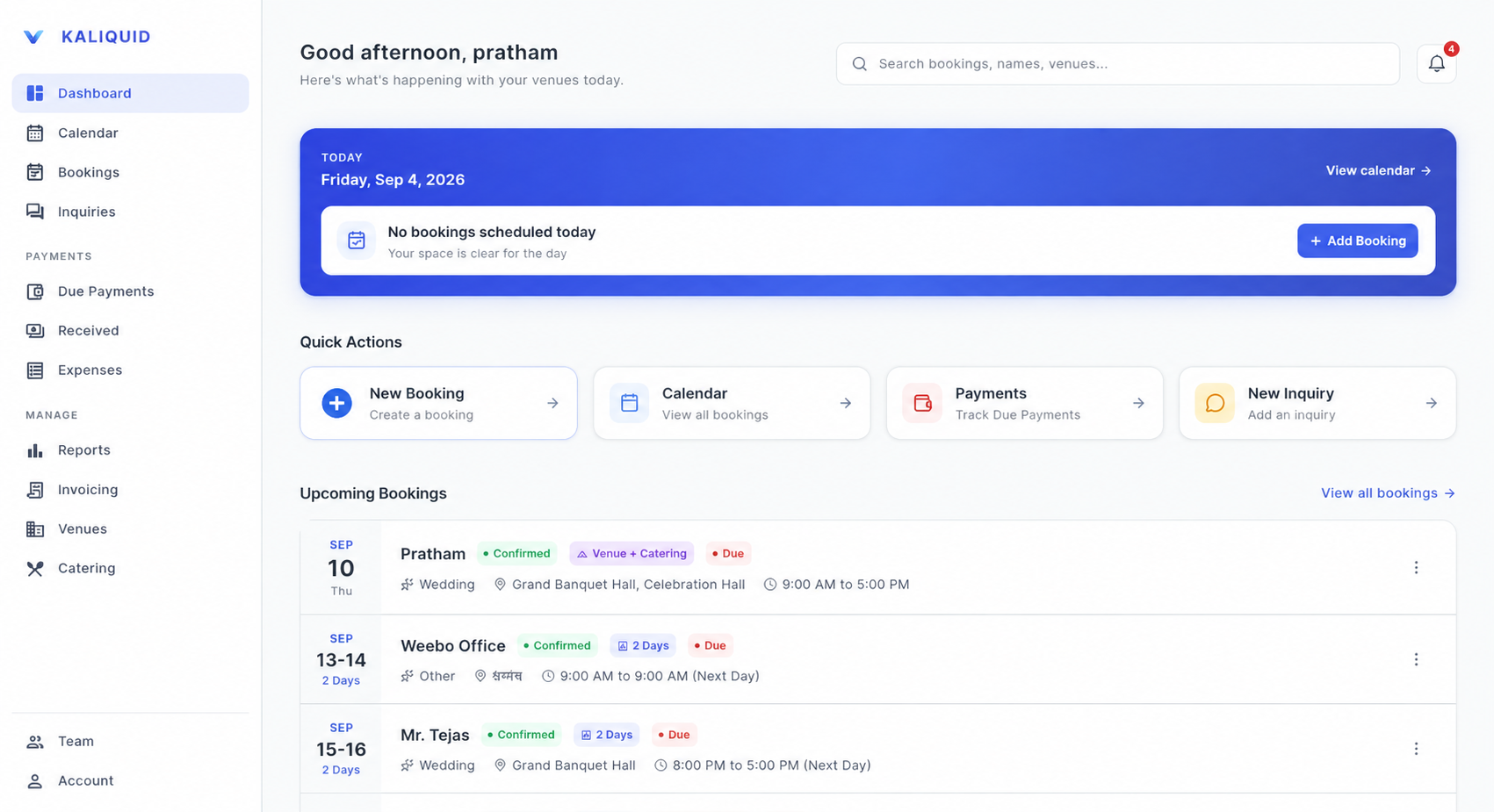
Kaliquid keeps one calendar for every hall and lawn you run, warns when two staff try to hold the same muhurat night, and lets a hold expire automatically if the advance does not arrive. Quotes go out on WhatsApp with the package, the guaranteed plates and the extra-plate rate, and every receipt carries CGST and SGST for Delhi under state code 07. Advances and balances stay attached to the booking, so the final bill does not depend on someone's notebook.
The Pro plan is ₹999 per hall per month, or ₹750 a month billed yearly, with a 30-day free trial; groups with many halls or farmhouses can ask for Enterprise pricing. It runs on Android, iOS and in any browser, and exports to Tally for your accountant.
Questions venue owners in Delhi NCR ask
Does a Delhi farmhouse need its own liquor licence to host weddings with a bar?
Not necessarily. For each function the host can take a P-10 permit from the Delhi Excise Department. The listed fee is ₹15,000 where the venue is a banquet hall, farm or motel without its own liquor licence, and ₹7,500 otherwise. The bar area must be screened from public view and served only to guests aged 25 or older.
Can we serve liquor at a Delhi wedding on a dry day?
According to the Excise Department FAQ, P-10 and P-13 permits can be granted on other dry days but not on the three national holidays: Republic Day, Independence Day and Gandhi Jayanti. If a family books one of those dates, tell them at the enquiry stage so the bar plan is not a surprise.
What does the Delhi Fire Service require for a wedding pandal?
Its temporary-structure guidance asks for a 4.5 metre margin from existing buildings, exits at least 2.5 metres wide on all sides, a ceiling at least 3 metres high, no synthetic cloth or ropes, a kitchen separated by non-combustible sheets, and no fireworks or open flames near the structure. Check these with your tent contractor before guests arrive.
How should a Delhi banquet hall bill guests above the confirmed count?
Put a minimum guaranteed plate count, the rate per extra plate and the counting method into the booking itself, and repeat them on the WhatsApp quote and the invoice. Agree that your captain and the family's representative count together, and reconcile before the final bill is printed so the settlement is arithmetic, not argument.
Is GST on a Delhi farmhouse booking 5% or 18%?
If the farmhouse only rents space and the family brings its own caterer, the hire is taxed at 18% with CGST and SGST under Delhi state code 07. If the venue supplies hall and food together as one package at an ordinary venue, the package is 5% without input credit. At specified premises such as many hotels, food carries 18%.
Can loud music continue after 10 pm on a farmhouse lawn?
The Noise Pollution Rules, 2000 prohibit loudspeakers between 10 pm and 6 am except in closed premises like banquet halls. An open lawn does not qualify unless a notified festive relaxation applies. Move amplified music indoors or end it on time, and write the cut-off into the DJ and venue contracts.
Venue guides for nearby cities
Sources
- Delhi Excise Department: P-10 and P-13 permits (checked 2026-09-25)
- Delhi Excise Department: frequently asked questions (checked 2026-09-25)
- Delhi Fire Service: temporary structures (checked 2026-09-25)
- CPCB: Noise Pollution (Regulation and Control) Rules, 2000 (checked 2026-09-25)
- GST e-way bill system: state code list (checked 2026-09-25)
General information for venue operators, reviewed 2026-09-25. Licences, fees and dates change, so confirm with the issuing department before you rely on them.
Run your Delhi NCR venue from one calendar
Bookings, advances, GST invoices and receipts in one place. Plans start at ₹999 per hall per month, with a 30-day free trial.
Start your free 30-day trial →Ready to modernize your event business?
Explore the Kaliquid ecosystem or speak with our team.